what was the heir to the roman empire called
| Emperor of the Roman Empire | |
|---|---|
| Regal | |
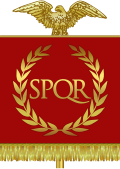 Vexillum of the emperor | |
 Offset to command | |
| Details | |
| Style | Imperator, Augustus, Caesar, Princeps, Dominus Noster, Autokrator or Basileus (depending on menstruation) |
| First monarch | Augustus |
| Last monarch | Theodosius I (Unified or Classical), Julius Nepos (Western), Constantine XI (Eastern) |
| Formation | sixteen January 27 BC |
| Abolition | 17 January 395 Advertisement (Unified), 22 June 480 Advertizement (Western), 29 May 1453 Advertising (Eastern) |
| Appointer | Roman Senate (officially) and/or Roman Armed services |
The Roman emperor was the ruler of the Roman Empire during the majestic period (starting with the granting of the championship augustus to Octavian in 27 BC). The emperors used a variety of different titles throughout history. Often when a given Roman is described as becoming "emperor" in English it reflects his taking of the title augustus (and afterwards basileus). Some other title oftentimes used was caesar, used for heirs-apparent, and imperator, originally a military honorific. Early emperors also used the championship princeps civitatis ('kickoff citizen'). Emperors ofttimes amassed republican titles, notably princeps senatus, consul, and pontifex maximus.
The legitimacy of an emperor'southward rule depended on his command of the army and recognition by the Senate; an emperor would usually be proclaimed by his troops, or invested with regal titles past the Senate, or both. The starting time emperors reigned alone; later emperors would sometimes rule with co-emperors and carve up administration of the empire between them.
The Romans considered the office of emperor to exist distinct from that of a rex. The beginning emperor, Augustus, resolutely refused recognition equally a monarch.[1] For the first 3 hundred years of Roman emperors, from Augustus until Diocletian, efforts were made to portray the emperors as leaders of the republic, fearing whatever association with the kings of Rome prior to the Republic.
From Diocletian, whose tetrarchic reforms also divided the position into one emperor in the West and one in the East, until the terminate of the Empire, emperors ruled in an openly monarchic style[2] and did not preserve the nominal principle of a republic, merely the contrast with "kings" was maintained: although the purple succession was generally hereditary, information technology was only hereditary if in that location was a suitable candidate adequate to the regular army and the hierarchy,[three] so the principle of automated inheritance was not adopted. Elements of the republican institutional framework (senate, consuls, and magistrates) were preserved even afterward the cease of the Western Empire.
The reign of Constantine the Corking witnessed the removal of the Head Mundi from Rome to Constantinople, formerly known as Byzantium, in 330 AD. The Western Roman Empire collapsed in the late 5th century after multiple invasions of regal territory by Germanic barbaric tribes. Romulus Augustulus is frequently considered to have been the final emperor of the W, until his forced abdication in 476, although Julius Nepos maintained a claim recognized by the Eastern Empire to the title until his death in 480. Following Nepos' expiry, the Eastern emperor Zeno abolished the division of the position and proclaimed himself equally the sole emperor of a reunited Roman Empire. The subsequent Eastern emperors ruling from Constantinople continued to fashion themselves "Emperor of the Romans" (afterwards βασιλεύς Ῥωμαίων in Greek), but are often referred to in modern scholarship as Byzantine emperors. Constantine Eleven Palaiologos was the last Roman emperor in Constantinople, dying during the Fall of Constantinople to the Ottoman Empire in 1453.
The "Byzantine" emperors from Heraclius in 629 and onwards adopted the monarchic title of basileus ( βασιλεύς ), which became a championship reserved solely for the Roman emperor and the ruler of the Sasanian Empire. Other rulers were and so referred to every bit rēgas.[4]
In add-on to their pontifical part, some emperors were given divine condition after death. With the eventual hegemony of Christianity, the emperor came to be seen equally God'south chosen ruler, also as a special protector and leader of the Christian Church on Globe, although in practice an emperor's potency on Church matters was subject to challenge.
Due to the cultural rupture of the Turkish conquest, most western historians treat Constantine Eleven as the last meaningful claimant to the title Roman emperor. From 1453, 1 of the titles used by the Ottoman Sultans was "Caesar of Rome" (Turkish: Kayser-i Rum),[5] part of their titles until the Ottoman Empire ended in 1922. A Byzantine group of claimant Roman emperors existed in the Empire of Trebizond until its conquest by the Ottomans in 1461, though they had used a modified championship since 1282.
Eastern emperors in Constantinople had been recognized and accepted as Roman emperors both in the East, which they ruled, and by the papacy and Germanic kingdoms of the West until the deposition of Constantine Half dozen and accession of Irene of Athens as Empress regnant in 797. Objecting to a adult female ruling the Roman Empire in her ain correct and problems with the eastern clergy, the Papacy would so create a rival lineage of Roman emperors in western Europe, the Holy Roman Emperors, which ruled the Holy Roman Empire for virtually of the menstruation between 800 and 1806. These emperors were never recognized equally Roman emperors past the court in Constantinople and their coronations resulted in the medieval trouble of two emperors.
Background and outset [edit]

Statue of Augustus, c. 30 BC–twenty BC; this statue is located in the Louvre
Modernistic historians conventionally regard Augustus as the commencement Emperor whereas Julius Caesar is considered the last dictator of the Roman Republic, a view having its origins in the Roman writers Plutarch, Tacitus and Cassius Dio.[vi] However, the majority of Roman writers, including Josephus, Pliny the Younger, Suetonius and Appian, as well as virtually of the ordinary people of the Empire, thought of Julius Caesar as the first Emperor.[vii]
At the finish of the Roman Republic no new, and certainly no unmarried, title indicated the individual who held supreme power. Insofar as emperor could be seen as the English translation of imperator, then Julius Caesar had been an emperor, like several Roman generals before him. Instead, past the end of the civil wars in which Julius Caesar had led his armies, it became clear that there was certainly no consensus to render to the old-style monarchy, but that the menstruation when several officials, bestowed with equal power by the senate, would fight one another had come up to an stop.
Julius Caesar, and then Augustus later on him, accumulated offices and titles of the highest importance in the Democracy, making the power fastened to those offices permanent, and preventing anyone with similar aspirations from accumulating or maintaining ability for themselves. However, Julius Caesar, unlike those subsequently him, did so without the Senate's vote and approval.[ citation needed ]
Julius Caesar held the Republican offices of consul four times and dictator five times, was appointed dictator in perpetuity (dictator perpetuo) in 45 BC and had been "pontifex maximus" for a long catamenia. He gained these positions past senatorial consent and just prior to his assassination, was the most powerful man in the Roman earth.

In his volition, Caesar appointed his adopted son Octavian as his heir. On Caesar's death, Octavian inherited his adoptive father'south property and lineage, the loyalty of almost of his allies and – again through a formal process of senatorial consent – an increasing number of the titles and offices that had accrued to Caesar. A decade subsequently Caesar'southward expiry, Octavian's victory over his one-time ally Mark Antony at Actium put an stop to whatsoever constructive opposition and confirmed Octavian'south supremacy.
In 27 BC, Octavian appeared before the Senate and offered to retire from active politics and government; the Senate non only requested he remain, but increased his powers and fabricated them lifelong, awarding him the title of Augustus (the elevated or divine i, somewhat less than a god but approaching divinity). Augustus stayed in office until his death; the sheer breadth of his superior powers as princeps and permanent imperator of Rome's armies guaranteed the peaceful continuation of what nominally remained a democracy. His "restoration" of powers to the Senate and the people of Rome was a sit-in of his auctoritas and pious respect for tradition.
Some later historians such equally Tacitus would say that fifty-fifty at Augustus' death, the true restoration of the Commonwealth might take been possible. Instead, Augustus actively prepared his adopted son Tiberius to exist his successor and pleaded his instance to the Senate for inheritance on merit. The Senate disputed the issue but eventually confirmed Tiberius equally princeps. Once in power, Tiberius took considerable pains to observe the forms and day-to-day substance of republican government.
Classical catamenia [edit]
Rome had no single constitutional office, championship or rank exactly equivalent to the English title "Roman emperor". Romans of the Royal era used several titles to denote their emperors, and all were associated with the pre-Imperial, Republican era.
The legal authority of the emperor derived from an extraordinary concentration of private powers and offices that were extant in the Commonwealth rather than from a new political function; emperors were regularly elected to the offices of delegate and censor.[8] Among their permanent privileges were the traditional Republican title of princeps senatus (leader of the Senate) and the religious part of pontifex maximus (chief priest of the College of Pontiffs). Every emperor held the latter office and title until Gratian surrendered it in Advertising 382 to Pope Siricius; it eventually became an auxiliary honor of the Bishop of Rome.
These titles and offices conferred not bad personal prestige (dignitas) but the basis of an emperor's powers derived from his auctoritas: this assumed his greater powers of command (imperium maius) and tribunician power (tribunicia potestas) as personal qualities, separate from his public role. Equally a result, he formally outranked provincial governors and ordinary magistrates. He had the right to enact or revoke sentences of capital punishment, was owed the obedience of private citizens (privati) and past the terms of the ius auxiliandi could save any plebeian from whatsoever patrician magistrate's decision. He could veto whatsoever act or proposal of any magistrate, including the tribunes of the people (ius intercedendi or ius intercessionis). His person was held to be sacred.
Roman magistrates on official business were expected to wear the form of toga associated with their office; unlike togas were worn past different ranks; senior magistrates had the correct to togas bordered with imperial. A triumphal imperator of the Commonwealth had the right to wear the toga picta (of solid purple, richly embroidered) for the duration of the triumphal rite. During the Tardily Republic, the most powerful had this right extended. Pompey and Caesar are both thought to take worn the triumphal toga and other triumphal wearing apparel at public functions. Later emperors were distinguished by wearing togae purpurae, purple togas; hence the phrase "to don the imperial" for the assumption of imperial dignity.
The titles customarily associated with the imperial dignity are imperator ("commander"), which emphasizes the emperor's military supremacy and is the source of the English language word emperor; Caesar, which was originally a name just came to be used for the designated heir (as Nobilissimus Caesar, "Virtually Noble Caesar") and was retained upon accession. The ruling emperor'southward championship was the descriptive Augustus ("majestic" or "venerable", which had tinges of the divine), which was adopted upon accretion. In Greek, these three titles were rendered equally autokratōr (" Αὐτοκράτωρ "), kaisar (" Καίσαρ "), and augoustos (" Αὔγουστος ") or sebastos (" Σεβαστός ") respectively. In Diocletian's Tetrarchy, the traditional seniorities were maintained: "Augustus" was reserved for the two senior emperors and "Caesar" for the two junior emperors – each delegated a share of power and responsibility but each an emperor-in-waiting, should anything befall his senior.
As princeps senatus (lit., "showtime human being of the senate"), the emperor could receive foreign embassies to Rome; some emperors (such as Tiberius) are known to have delegated this task to the Senate. In modern terms, these early on emperors would tend to be identified as chiefs of state. The role of princeps senatus, however, was not a magistracy and did not entail imperium. At some points in the Empire's history, the emperor'south ability was nominal; powerful praetorian prefects, masters of the soldiers and on a few occasions, other members of the Imperial household including Royal mothers and grandmothers were the true source of power.
Imperator [edit]
The title imperator dates back to the Roman Commonwealth, when a victorious commander could be hailed as imperator in the field by his troops. The Senate could then award or withhold the extraordinary honour of a triumph; the triumphal commander retained the title until the end of his magistracy.[9] In Roman tradition, the first triumph was that of Romulus, but the first attested recipient of the title imperator in a triumphal context is Aemilius Paulus in 189 BC.[9] It was a championship held with bully pride: Pompey was hailed imperator more than than once, equally was Sulla, only it was Julius Caesar who first used it permanently – according to Dio, this was a singular and excessive form of flattery granted by the Senate, passed to Caesar'due south adopted heir along with his name and virtually synonymous with information technology.[x]
In 38 BC, Agrippa refused a triumph for his victories nether Octavian's command, and this precedent established the rule that the princeps should assume both the salutation and title of imperator. It seems that from and so on Octavian (later the beginning emperor Augustus) used imperator as a first name (praenomen): Imperator Caesar non Caesar imperator. From this the championship came to denote the supreme ability and was ordinarily used in that sense. Otho was the first to imitate Augustus, merely but with Vespasian did imperator (emperor) become the official title past which the ruler of the Roman Empire was known.
Princeps [edit]
The give-and-take princeps (plural principes), significant "start", was a republican term used to announce the leading citizen(s) of the land. It was a purely honorific title with no attached duties or powers. It was the title most preferred by Augustus as its use implies just primacy, as opposed to another of his titles, imperator, which implies dominance. Princeps, because of its republican connotation, was most normally used to refer to the emperor in Latin (although the emperor'due south bodily constitutional position was essentially "pontifex maximus with tribunician power and imperium superseding all others") as it was in keeping with the façade of the restored Republic; the Greek give-and-take basileus ("king") was modified to be synonymous with emperor (and primarily came into favour after the reign of Heraclius) as the Greeks had no republican sensibility and openly viewed the emperor as a monarch.
In the era of Diocletian and beyond, princeps fell into disuse and was replaced with dominus ("lord");[eleven] later emperors used the formula Imperator Caesar NN. Pius Felix (Invictus) Augustus: NN representing the individual'south personal name; Pius Felix meaning "Pious and Blest"; and Invictus pregnant "undefeated". The use of princeps and dominus broadly symbolise the differences in the empire's government, giving rise to the era designations "Principate" and "Dominate".
Evolution in Late Antiquity [edit]
In 293, following the Crisis of the Third Century which had severely damaged Imperial assistants, Emperor Diocletian enacted sweeping reforms that done away many of the vestiges and façades of republicanism which had characterized the Augustan club in favor of a more than frank autocracy. Equally a consequence, historians distinguish the Augustan period as the principate and the period from Diocletian to the 7th-century reforms of Emperor Heraclius every bit the dominate (from the Latin for "lord".)
Reaching back to the oldest traditions of job-sharing in the democracy, however, Diocletian established at the top of this new construction the Tetrarchy ("rule of 4") in an attempt to provide for smoother succession and greater continuity of government. Nether the Tetrarchy, Diocletian set in place a organization of co-emperors, styled "Augustus", and junior emperors, styled "Caesar". When a co-emperor retired (as Diocletian and his co-emperor Maximian did in 305) or died, a junior "Caesar" would succeed him and the co-emperors would engage new Caesars as needed.
The four members of the Imperial college (every bit historians call the system) shared military and authoritative challenges by each being assigned specific geographic areas of the empire. From this innovation, frequently but not consistently repeated over the next 187 years, comes the notion of an east–west sectionalization of the empire that became popular with historians long subsequently the practice had stopped. The 2 halves of empire, while ofttimes run equally de facto split up entities day-to-solar day, were always considered and seen, legally and politically, every bit separate administrative divisions of a single, insoluble imperium by the Romans of the time.


When emperor Theodosius I died, his sons Arcadius and Honorius, already proclaimed augusti, succeeded him. Eighty-five years after, following Germanic migrations which had reduced the empire'due south effective control beyond Brittania, Gaul and Hispania and a series of military coup d'état which collection Emperor Nepos out of Italy, the idea of dividing the position of emperor was formally abolished by Emperor Zeno (480).
The Roman Empire survived in the eastward until 1453, but the marginalization of the former heartland of Italy to the empire[ clarification needed ] had a profound cultural impact on the empire and the position of emperor. The Greek-speaking inhabitants were Romaioi (Ῥωμαῖοι), and were still considered Romans by themselves and the populations of Eastern Europe, the Well-nigh Eastward, Bharat, and Red china. Merely many in Western Europe began to refer to the political entity equally the "Greek Empire". The evolution of the church in the no-longer regal city of Rome and the church building in the now supreme Constantinople began to follow divergent paths, culminating in the schism between the Roman Cosmic and Eastern Orthodox faiths. The position of emperor was increasingly influenced by Near Eastern concepts of kingship. Starting with Emperor Heraclius, Roman emperors styled themselves "King of Kings" (from the purple Western farsi Shahanshah) from 627 and "Basileus" (from the title used by Alexander the Great) from 629. The subsequently period of the empire is today called the Byzantine Empire every bit a matter of scholarly convention.[ commendation needed ]
Titles and positions [edit]
Although these are the most common offices, titles, and positions, not all Roman emperors used them, nor were all of them used at the same time in history. The consular and censorial offices specially were non an integral part of the Regal nobility, and were unremarkably held by persons other than the reigning emperor.
- Augustus: (likewise " Αὔγουστος " or " Σεβαστός "), "Purple" or "Venerable"; an honorific cognomen exclusive to the emperor
- Autokrator: ( Αὐτοκράτωρ , Autokratōr), (lit. "Self-ruler"); Greek championship equivalent to imperator or commander-in-chief
- Basileus: ( Βασιλεύς ), Greek for monarch, often translated as king, popularly used in the east to refer to the emperor; a formal championship of the Roman emperor showtime with Heraclius
- Caesar: (also " Καίσαρ "), initially the cognomen of Julius Caesar, it was transformed into a title; an honorific name afterwards used to place an emperor-designate
- Censor: a Republican office held jointly by two former consuls every five years for the purpose of conducting the lustrum that adamant the function of citizens; the censor could audit all other magistrates and all state finances
- Delegate: the highest magistracy of the Roman Republic with a one-year term and ane coequal officeholder; the consul was the head of country within Rome. The last emperor to be bestowed the title by the Senate was Constans 2, who was as well the concluding emperor to visit Rome.
- Dominus ("Lord" or "Main"): an honorific title mainly associated with the Dominate
- Dominus Noster ("Our Lord"): an honorific title; the praenomen of later emperors.[ citation needed ]
- Imperator ("Commander" or "Commander-in-Chief"): a victory title taken on accession to the purple and later a major military victory
- Imperator Destinatus ("Destined to be Emperor"): heir credible, used past Septimius Severus for Caracalla
- Invictus ("Unconquered"), an honorific championship.
- Nobilissimus: ( Nωβελίσσιμος , Nōbelissimos), ("Most Noble"), one of the highest imperial titles held by the emperor
- Pater Patriae ("Father of the Fatherland"): an honorific title

- Perpetuus ("Universal"): an honorific title of afterward emperors
- Pius Felix ("Pious and Blessed"): an honorific title
- Pontifex Maximus ("Supreme Pontiff" or "Principal Priest"): in the Republican era, the Pontifex Maximus was the head of the College of Pontiffs, the religious body that oversaw the bequeathed public faith of the Romans; Julius Caesar had become Pontifex Maximus before he was elected consul, and the precedent prepare by his heir Augustus in consolidating supreme authority through this religious office was in general followed by his successors until the empire came nether Christian rule
- Princeps ("First Denizen" or "Leading Citizen"): an honorific championship denoting the condition of the emperor as first among equals, associated mainly with the Principate
- Princeps Iuventutis: ("Prince of Youth"), an honorific title awarded to a presumptive emperor-designate
- Princeps Senatus: ("Outset Man of the Senate"), a Republican role with a 5-year term
- Sebastos: ( Σεβαστός ), ("Venerable"); the Greek rendition of the imperial title Augustus
- Sebastokrator: ( Σεβαστοκράτωρ , Sebastokratōr), ("Venerable Ruler); a senior court title from the compound words "sebastos" ("venerable", the Greek equivalent of the Latin Augustus) and "kratōr" ("ruler", the aforementioned element equally is constitute in "autokratōr", "emperor")
- Tribunicia Potestas: ("Tribunician Ability"); the powers of a tribune of the people, including sacrosanctity and inviolability of his person, and the veto over any decision past whatever other magistrate, assembly, or the Senate (the emperor could not be a "tribune" because a tribune was a plebeian by definition, therefore the emperor had all the powers of a tribune without really being one)
Powers [edit]
When Augustus established the Princeps, he turned downwardly supreme authority in exchange for a collection of diverse powers and offices, which in itself was a demonstration of his auctoritas ("authority"). Equally holding princeps senatus, the emperor declared the opening and closure of each Senate session, declared the Senate's calendar, imposed rules and regulation for the Senate to follow, and met with foreign ambassadors in the name of the Senate. Being pontifex maximus fabricated the emperor the chief administrator of religious diplomacy, granting him the power to conduct all religious ceremonies, consecrate temples, control the Roman calendar (adding or removing days equally needed), engage the vestal virgins and some flamens, lead the Collegium Pontificum, and summarize the dogma of the Roman organized religion.
While these powers granted the emperor a swell deal of personal pride and influence, they did not include legal authority. In 23 BC, Augustus gave the emperorship its legal power. The first was Tribunicia Potestas, or the powers of the tribune of the plebs without really holding the office (which would accept been impossible, since a tribune was by definition a plebeian, whereas Augustus, although built-in into a plebeian family, had become a patrician when he was adopted into the gens Julia). This endowed the emperor with inviolability (sacrosanctity) of his person, and the ability to pardon whatever civilian for any act, criminal or otherwise. Past property the powers of the tribune, the emperor could prosecute anyone who interfered with the performance of his duties. The emperor's tribuneship granted him the right to convene the Senate at his will and lay proposals before it, likewise as the ability to veto any act or proposal past any magistrate, including the actual tribune of the plebeians. Also, every bit holder of the tribune's power, the emperor would convoke the Council of the People, lay legislation before it, and served every bit the council's president. Just his tribuneship only granted him power inside Rome itself. He would need another ability to veto the deed of governors and that of the consuls while in the provinces.
To solve this trouble, Augustus managed to have the emperor be given the right to hold two types of imperium. The first being consular imperium while he was in Rome, and imperium maius outside of Rome. While within the walls of Rome, the reigning consuls and the emperor held equal authority, each being able to veto each other's proposals and acts, with the emperor holding all of the consul's powers. Only outside of Rome, the emperor outranked the consuls and could veto them without the same effects on himself. Imperium Maius besides granted the emperor authority over all the provincial governors, making him the ultimate authority in provincial matters and gave him the supreme command of all of Rome's legions. With Imperium Maius, the emperor was likewise granted the power to engage governors of imperial provinces without the interference of the Senate. Too, Imperium Maius granted the emperor the correct to veto the governors of the provinces and even the reigning consuls while in the provinces.
Normally, the powers vested in Augustus would take been split between several people, who would each do them with the assistance of a colleague and for a specific catamenia of time. Augustus held them all at once by himself, and with no time limits; even those that nominally had fourth dimension limits were automatically renewed whenever they lapsed.[12]
Lineages and epochs [edit]

Principate [edit]
The nature of the imperial office and the Principate was established nether Julius Caesar's heir and posthumously adopted son, Augustus, and his own heirs, the descendants of his wife Livia from her first union to a scion of the distinguished Claudian clan. This Julio-Claudian dynasty came to an finish when the Emperor Nero – a great-great-grandson of Augustus through his daughter and of Livia through her son – was deposed in 68.
Nero was followed by a succession of usurpers throughout 69, commonly called the "Year of the Iv Emperors". The last of these, Vespasian, established his own Flavian dynasty. Nerva, who replaced the last Flavian emperor, Vespasian'due south son Domitian, in 96, was elderly and childless, and chose therefore to adopt an heir, Trajan, from exterior his family. When Trajan acceded to the royal he chose to follow his predecessor's case, adopting Hadrian as his own heir, and the practice so became the customary manner of purple succession for the next century, producing the "Five Skilful Emperors" and the Empire's flow of greatest stability.
The last of the Expert Emperors, Marcus Aurelius, chose his natural son Commodus as his successor rather than adopting an heir. A cursory menses of instability speedily gave way to Septimius Severus, who established the Severan dynasty which, except for an pause in 217–218 when Macrinus was emperor, held the imperial until 235.
Crisis of the 3rd Century [edit]
The accession of Maximinus Thrax marks both the close and the opening of an era. It was one of the final attempts by the increasingly impotent Roman Senate to influence the succession. Nonetheless it was the 2d fourth dimension that a man had accomplished the purple while owing his advancement purely to his military career; both Vespasian and Septimius Severus had come from noble or heart-class families, while Thrax was born a commoner. He never visited the city of Rome during his reign,[thirteen] which marks the beginning of a series of "billet emperors" who came from the regular army. Between 235 and 285 over a dozen emperors accomplished the purple, simply only Valerian and Carus managed to secure their own sons' succession to the throne; both dynasties died out inside 2 generations.
Dominate [edit]
The accretion on 20 November 284, of Diocletian, the lower-class, Greek-speaking Dalmatian commander of Carus' and Numerian's household cavalry (protectores domestici), marked major innovations in Rome's government and constitutional theory. Diocletian, a traditionalist and religious bourgeois, attempted to secure efficient, stable government and a peaceful succession with the establishment of the Tetrarchy. The empire was divided into East and West, each ruled by an Augustus assisted by a Caesar as emperor-in-waiting. These divisions were further subdivided into new or reformed provinces, administered by a complex, hierarchic bureaucracy of unprecedented size and scope. Diocletian's ain courtroom was based at Nicomedia. His co-Augustus, Maximian, was based at Mediolanum (modern Milan). Their courts were peripatetic, and Imperial progressions through the provinces fabricated much employ of the impressive, theatrical adventus, or "Imperial arrival" ceremony, which employed an elaborate choreography of etiquette to emphasise the emperor'southward elevation above other mortals. Hyperinflation of imperial honours and titles served to distinguish the Augusti from their Caesares, and Diocletian, every bit senior Augustus, from his colleague Maximian. The senior Augustus in detail was made a split up and unique being, accessible only through those closest to him. The overall unity of the Empire however required the highest investiture of power and condition in one man.[14]
The Tetrarchy ultimately degenerated into civil war, merely the eventual victor, Constantine the Great, restored Diocletian's partitioning of Empire into E and W. He kept the East for himself and founded his metropolis of Constantinople as its new upper-case letter. Constantine'south own dynasty was also soon swallowed upward in ceremonious war and court intrigue until information technology was replaced, briefly, by Julian the Apostate's full general Jovian so, more than permanently, by Valentinian I and the dynasty he founded in 364. Though a soldier from a low middle-class groundwork, Valentinian was made emperor by a conclave of senior generals and ceremonious officials.
Theodosius I acceded to the purple in the East in 379 and in the Due west in 394. He outlawed paganism and made Christianity the Empire's official organized religion. He was the last emperor to rule over a united Roman Empire; the distribution of the Eastward to his son Arcadius and the West to his son Honorius after his decease in 395 represented a permanent division.
Decline of the Western Roman Empire [edit]
In the Western Roman Empire, the office of emperor soon degenerated into beingness little more than than a puppet of a succession of Germanic tribal kings, until finally the Heruli Odoacer simply overthrew the child-emperor Romulus Augustulus in 476, shipped the majestic regalia to the Emperor Zeno in Constantinople and became King of Italy.
Though during his own lifetime Odoacer maintained the legal fiction that he was actually ruling Italy as the viceroy of Zeno, historians mark 476 equally the traditional appointment of the fall of the Western Roman Empire. Large parts of Italy (Sicily, the s part of the peninsula, Ravenna, Venice etc.), however, remained under bodily imperial rule from Constantinople for centuries, with imperial control slipping or becoming nominal only as late equally the 11th century. In the Eastward, the Empire continued until the fall of Constantinople to the Ottoman Turks in 1453. Although known every bit the Byzantine Empire past contemporary historians, the Empire was simply known as the Roman Empire to its citizens and neighboring countries.
Post-classical assertions to the championship [edit]
Survival of the Roman Empire in the East [edit]

Imaginary portrait of Constantine Eleven, the last Roman emperor of the Eastern Roman empire
The line of Roman emperors in the Eastern Roman Empire continued unbroken at Constantinople until the capture of Constantinople in 1204 past the Fourth Crusade. In the wake of this action, four lines of Emperors emerged, each challenge to exist the legal successor: the Empire of Thessalonica, evolving from the Despotate of Epirus, which was reduced to impotence when its founder Theodore Komnenos Doukas was defeated, captured and blinded past the Bulgarian Emperor Ivan Asen III;[15] the Latin Empire, which came to an end when the Empire of Nicaea recovered Constantinople in 1261; the Empire of Trebizond, whose importance declined over the 13th century, and whose claims were simply ignored;[16] and the Empire of Nicaea, whose claims based on kinship with the previous emperors, control of the Patriarch of Constantinople, and possession of Constantinople through military prowess, prevailed. The successors of the emperors of Nicaea continued until the autumn of Constantinople in 1453 under Constantine XI Palaiologos.
These emperors eventually normalized the imperial dignity into the modern conception of an emperor, incorporated information technology into the constitutions of the state, and adopted the aforementioned title Basileus kai autokratōr Rhomaiōn ("Emperor and Autocrat of the Romans"). They had also ceased to use Latin as the language of country after Emperor Heraclius (d. 641 Advertizing). Historians have customarily treated the country of these afterwards Eastern emperors nether the name "Byzantine Empire". Information technology is important to annotation, however, that the adjective Byzantine, although historically used by Eastern Roman authors in a metonymic sense[ citation needed ], was never an official term.
Final Roman emperor [edit]
Constantine XI Palaiologos was the concluding reigning Roman emperor. A member of the Palaiologos dynasty, he ruled the remnant of the Eastern Roman Empire from 1449 until his decease in 1453 defending its capital Constantinople.
He was born in Mystra[17] as the 8th of ten children of Manuel 2 Palaiologos and Helena Dragaš, the daughter of the Serbian prince Constantine Dragaš of Kumanovo. He spent most of his babyhood in Constantinople under the supervision of his parents. During the absence of his older brother in Italy, Constantine was regent in Constantinople from 1437 to 1440.
Earlier the beginning of the siege, Mehmed the Conqueror fabricated an offer to Constantine 11.[18] In exchange for the surrender of Constantinople, the emperor's life would exist spared and he would keep to rule in Mystra. Constantine refused this offer. Instead he led the defense of the city and took an active part in the fighting forth the state walls. At the same time, he used his diplomatic skills to maintain the necessary unity between the Genovese, Venetian, and Byzantine troops. As the city fell on May 29, 1453, Constantine is said to have remarked: "The urban center is fallen just I am alive." Realizing that the end had come, he reportedly discarded his majestic cloak and led his remaining soldiers into a final accuse, in which he was killed. With his death, Roman imperial succession came to an end, almost 1500 years after Augustus.
Holy Roman Empire [edit]

Charles V was the last emperor of the Holy Roman Empire to receive a papal coronation
The concept of the Roman Empire was renewed in the Due west with the coronation of the rex of the Franks, Charlemagne (Charles the Groovy), as Roman emperor by the Pope on Christmas Twenty-four hours, 800. This coronation had its roots in the decline of influence of the Pope in the affairs of the Byzantine Empire at the aforementioned time the Byzantine Empire declined in influence over politics in the West. The Pope saw no advantage to be derived from working with the Byzantine Empire, but equally George Ostrogorsky points out, "an alliance with the famous conquistador of the Lombards, on the other mitt ... promised much".[19]
The immediate response of the Eastern Roman emperor was not welcoming. "At that time information technology was axiomatic that there could exist only 1 Empire as there could be only one church building", writes Ostrogorsky. "The coronation of Charles the Slap-up violated all traditional ideas and struck a hard accident at Byzantine interests, for hitherto Byzantium, the new Rome, had unquestionably been regarded every bit the sole Empire which had taken over the inheritance of the erstwhile Roman imperium. Conscious of its imperial rights, Byzantium could only consider the height of Charles the Great to be an act of usurpation."[twenty]
Nikephoros I chose to ignore Charlemagne'due south claim to the majestic title, clearly recognizing the implications of this deed. According to Ostrogorsky, "he even went then far as to refuse the Patriarch Nicephorus permission to acceleration the customary synodica to the Pope."[21] Meanwhile, Charlemagne'southward power steadily increased: he subdued Istria and several Dalmatian cities during the reign of Irene, and his son Pepin brought Venice nether Western hegemony, despite a successful counter-attack by the Byzantine fleet. Unable to counter this inroad on Byzantine territory, Nikephoros' successor Michael I Rangabe capitulated; in return for the restoration of the captured territories, Michael sent Byzantine delegates to Aachen in 812 who recognized Charlemagne as Basileus.[22] Michael did not recognize him as Basileus of the Romans, all the same, which was a title that he reserved for himself.[23]
This line of Roman emperors was actually generally Germanic rather than Roman. These emperors used a diverseness of titles (most frequently "Imperator Augustus") before finally settling on Imperator Romanus Electus ("Elected Roman Emperor"). Historians customarily assign them the title "Holy Roman Emperor", which has a basis in actual historical usage, and treat their "Holy Roman Empire" as a separate establishment. To Latin Catholics of the fourth dimension, the Pope was the temporal authority too equally spiritual authority, and as Bishop of Rome he was recognized every bit having the power to anoint or crown a new Roman emperor. The last human being to be crowned past the pope (although in Bologna, not Rome) was Charles Five. All his successors diameter only a championship of "Elected Roman Emperor".
This line of Emperors lasted until 1806 when Francis 2 dissolved the Empire during the Napoleonic Wars. Despite the being of afterwards potentates styling themselves "emperor", such every bit the Napoleons, the Habsburg Emperors of Austria, and the Hohenzollern heads of the German Reich, this marked the terminate of the Holy Roman Empire.
See also [edit]
- Imperial cult of ancient Rome
- Interregnum
- Justitium
- Roman Emperors family tree
- Julio-Claudian family tree
- Severan dynasty family tree
- Roman usurper
Lists [edit]
- Listing of Roman emperors
- List of Byzantine emperors
- List of Roman usurpers
- List of condemned Roman emperors
- List of Regal Roman victory titles
References [edit]
Citations [edit]
- ^ Galinsky 2005, pp. thirteen–14
- ^ Williams 1997, p. 147
- ^ Heather 2005, p. 28
- ^ Kazhdan 1991, p. 264
- ^ İlber Ortaylı, "Büyük Constantin ve İstanbul", Milliyet, 28 May 2011.
- ^ Barnes 2009, pp. 278–279
- ^ Barnes 2009, pp. 279–282
- ^ Murray, John (1875). A Dictionary of Greek and Roman Antiquities. Academy of Chicago. pp. 260–266.
- ^ a b The Oxford Classical Dictionary, entry 'Imperator', Third Edition, Oxford University Printing, 1996.
- ^ Cassius Dio, 43.44.2.
- ^ Goldsworthy 2010, p. 443
- ^ Ancient Rome at Encyclopedia Britannica
- ^ Hekster, Olivier (2008). Rome and its Empire, AD 193–284. Edinburgh University Press. p. three. ISBN9780748629923 . Retrieved 29 July 2020.
- ^ Rees 2004, pp. 46–56, threescore
- ^ Ostrogorsky 1957, p. 387
- ^ On the royal claims of the G Komnenos and international response to them, see Northward. Oikonomides, "The Chancery of the Grand Komnenoi; Imperial Tradition and Political Reality", Archeion Pontou, 35 (1979), pp. 299–332
- ^ "Constantine Palaeologus the last Hellene emperor Fall of Constantinople". world wide web.agiasofia.com.
- ^ Mansel, Philip (1995). "Constantinople: Urban center of the World'south Desire 1453–1924". Washington Post. St. Martin's Press. Retrieved 21 August 2018. – Chapter 1 of Constantinople: City of the World'south Want 1453–1924
- ^ Ostrogorsky 1957, p. 164
- ^ Ostrogorsky 1957, p. 164f
- ^ Ostrogorsky 1957, p. 175
- ^ Ostrogorsky 1957, p. 176
- ^ Eichmann, Eduard (1942). Die Kaiserkrönung im Abendland: ein Beitrag zur Geistesgeschichte des Mittelalters, mit besonderer Berücksichtigung des kirchlichen Rechte, der Liturgie und der Kirchenpolitik. Echter-Verlag. p. 33.
Sources [edit]
- Alston, Richard (1998). Aspects of Roman history, AD xiv–117. Psychology Press. ISBN978-0-415-13237-4 . Retrieved 2011-08-03 .
- Barnes, Timothy (2009). "The commencement Emperor: the view of late antiquity". In Griffin, Miriam (ed.). A Companion to Julius Caesar. John Wiley & Sons. ISBN978-i-4443-0845-vii.
- Galinsky, Karl (2005). The Cambridge companion to the Age of Augustus. Cambridge University Printing. ISBN978-0-521-80796-8 . Retrieved 2011-08-03 .
- Goldsworthy, Adrian (2010). How Rome Roughshod: Expiry of a Superpower . Yale University Press. ISBN9780300164268.
- Heather, Peter (2005). The Autumn of the Roman Empire. ISBN978-0-330-49136-5 . Retrieved 2011-08-03 .
- Kazhdan, Alexander, ed. (1991), Oxford Dictionary of Byzantium, Oxford University Press, ISBN978-0-19-504652-6
- Ostrogorsky, George (1957). History of the Byzantine State. Translated by Hussey, Joan. New Brunswick: Rutgers University Press.
- Rees, Roger (2004). Diocletian and the Tetrarchy. Edinburgh, Scotland: Edinburgh Academy Printing. ISBN9780748616602.
- Williams, Stephen (1997) [1985]. Diocletian and the Roman recovery. New York, NY: Routledge. ISBN978-0-415-91827-5 . Retrieved 2011-08-03 .
Further reading [edit]
- Scarre, Chris. Relate of the Roman Emperors: The Reign-by-Reign Tape of the Rulers of Imperial Rome. London: Thames & Hudson, October one, 1995. ISBN 0-500-05077-5 (hardcover).
External links [edit]
- De Imperatoribus Romanis
- Rulers of Rome
- "Decadence, Rome and Romania, and the Emperors Who Weren't", by Kelley L. Ross, Ph.D.
- UNRV.com
- The Roman Law Library
- List of Greatest Roman Emperors
- Emperors of Rome
Source: https://en.wikipedia.org/wiki/Roman_emperor#:~:text=The%20titles%20customarily%20associated%20with,Most%20Noble%20Caesar%22)%20and%20was
0 Response to "what was the heir to the roman empire called"
Post a Comment